
Collapse
Predictive Sidechain Ducker
Standard sidechain duckers are reactive. Collapse adds lookahead to shift the ducking envelope forward in time. The target can be attenuated before the sidechain hits.
Adjustable lookahead up to 25ms. Full envelope shaping with attack, hold, and release controls. Broadband and spectral ducking modes. Configurable mute window for full silence at the transient peak.
The Problem
Sidechain ducking is reactive by design. The detection circuit measures an incoming signal, computes a gain reduction value, and applies it — but these steps take time. By the time the envelope reaches its lowest point, the transient has already passed through the target signal at full level. The result is a brief window of overlap at maximum energy, precisely where headroom is most critical.
The common workaround is to draw volume automation by hand. In dense arrangements with multiple drum elements, this is a substantial time cost.
Collapse was built to eliminate this issue. An adjustable lookahead buffer shifts the entire ducking envelope forward in time, so gain reduction's deepest point can be aligned with the transient. The mute window extends this further — inserting a configurable window of silence at the envelope's attack point.
Technical Overview
Predictive Lookahead
Adjustable buffer up to 25ms shifts the ducking envelope forward in time. Gain reduction reaches maximum depth at the moment of transient arrival, not after. Equivalent latency is reported to the host for automatic delay compensation.
Mute Window
Inserts a configurable silence window (1–50ms) at the envelope trough. Combined with lookahead, the target is fully muted during the transient, buying more headroom without manual automation.
Envelope Shaping
Full control over ducking depth, attack, hold, and release. Shape the gain reduction envelope precisely — from soft, gradual dips to hard, punchy cuts — to match the character of the sidechain source.
Broadband and Spectral Modes
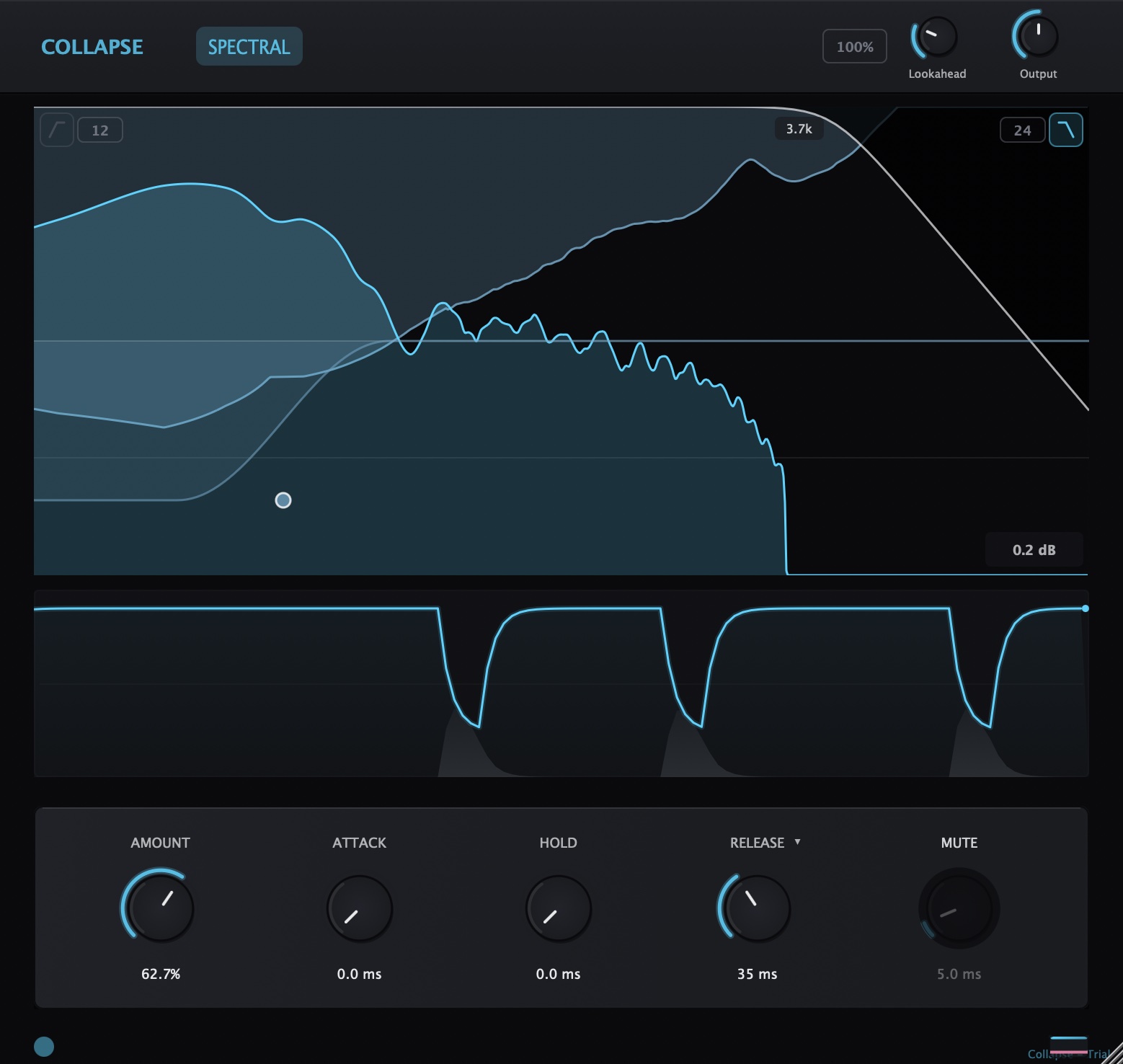
Operates in broadband or spectral mode. Spectral mode provides a draggable EQ curve with adjustable filter slopes to sculpt the frequency ranges that duck the target signal.
Efficient Processing
Lock-free message queue prevents audio thread blocking. Designed for stability at low buffer sizes with minimal CPU overhead.
Interface
Click the markers to explore key controls
Spectral / Broadband Toggle
Switches the active input between broadband and frequency-selective ducking. In spectral mode, only the frequency range defined by the input and EQ curve is attenuated. Broadband mode applies uniform gain reduction across the full spectrum.
Presets
Stores and recalls a complete processing configuration. Five factory presets ship built in and are read-only — saving over one keeps your version under a new name instead. A preset never changes which sidechain inputs are enabled, so recalling one cannot arm a bus with nothing routed to it.
Lookahead
Shifts the ducking envelope forward in time, up to 25ms. Lookahead allows predictive triggering of gain reduction before the transient arrives . Introduces equivalent latency, automatically compensated by the host.
Spectral Display
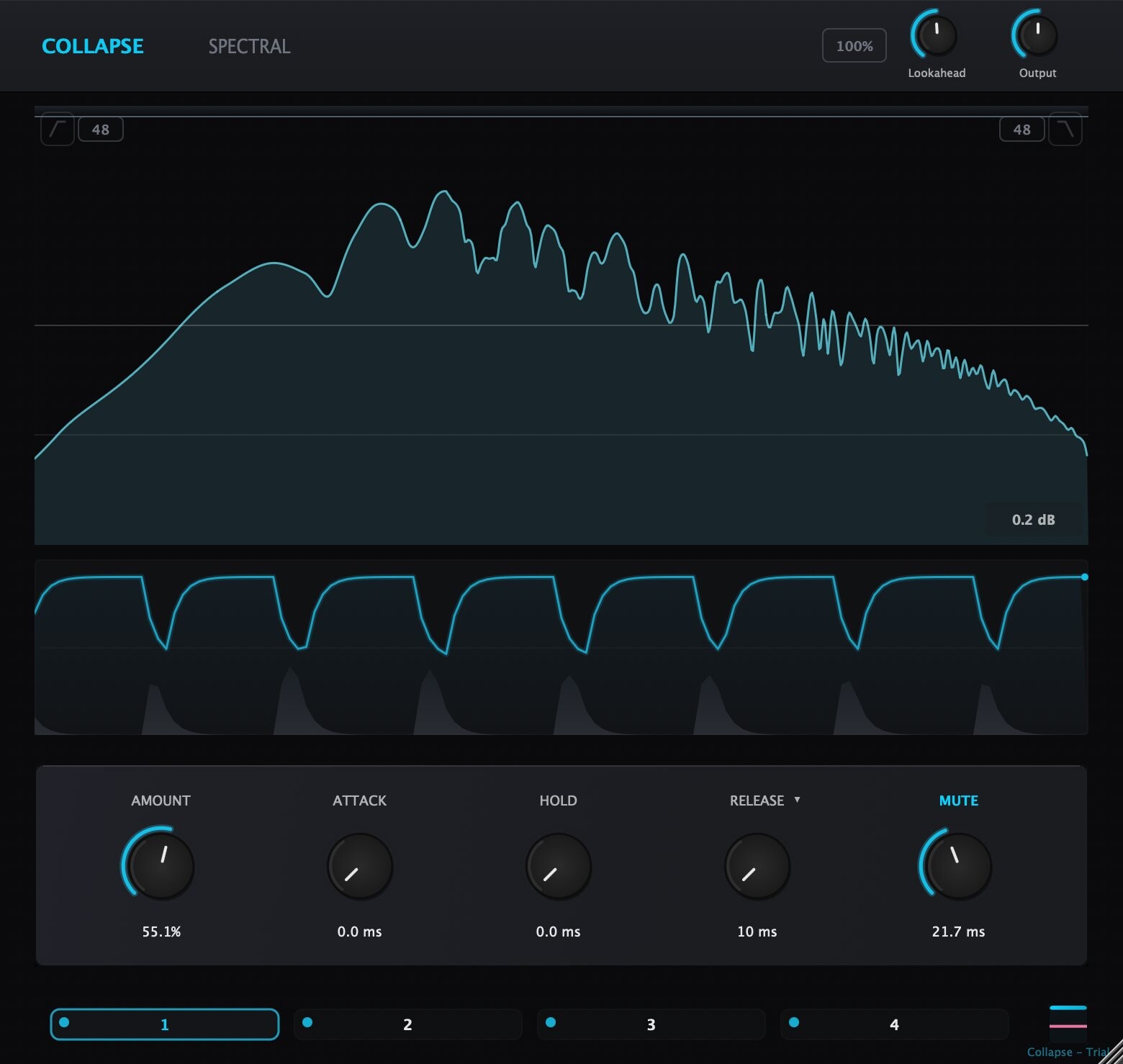
Real-time spectrum analyzer showing the sidechain input overlaid with the processed output. In spectral mode, the draggable EQ curve boosts the ducking frequency range. Filter slope is adjustable at both ends.
Spectral EQ
In spectral mode, a draggable EQ curve additively shapes the ducking spectrum. Boost a frequency range to increase ducking there — such as adding a low shelf to carve extra space for a kick. Filter slopes are adjustable at both ends.
Gain Reduction Display
Time-domain view of the ducking envelope. The upper trace shows the gain reduction curve; the lower region shows the sidechain trigger signal. Attack, hold, release, and mute window are visible in real time.
Envelope Controls
Controls for Amount, Attack, Hold, Release, and Mute Duration. Shape the ducking envelope to match the character of the sidechain source — from tight rhythmic pumping to smooth, transparent dips.
Mute Duration
Inserts a configurable silence window (1–50ms) at the envelope trough. Combined with lookahead, this creates a gap of true silence around the transient peak — without drawing a single automation point.
Capabilities
Pre-Transient Gain Reduction
The lookahead buffer shifts the ducking envelope forward in time. The envelope's deepest point can be aligned with the transient instead of its attack being initiated by the transient's arrival.
Configurable Mute Window
A 1–50ms silence window can be inserted at the envelope trough. With lookahead engaged, this produces a zone of true silence around the transient peak without any manual automation.
Full Envelope Control
Independent attack, hold, release, and ducking depth controls. Shape the gain reduction envelope precisely to match the character of the sidechain source.
Drag-to-Replace Sidechain Routing
A single sidechain input keeps routing simple. Swap the sidechain source by dragging a new send — no bus assignment menus, no stale slot management.
Spectral and Broadband Modes
Switch between broadband and spectral ducking. Spectral mode provides a draggable EQ curve with adjustable filter slopes to constrain ducking to specific frequency bands.
Adjustable Lookahead
Lookahead up to 25ms shifts the ducking envelope forward in time. A kick may require 20ms for full pre-transient attenuation; a hi-hat may need none. Latency is reported to the host automatically.
Real-Time Visualization
Gain reduction metering shows current ducking depth. The spectral analyzer displays sidechain input and output simultaneously. A time-domain view shows the full ducking envelope shape.
Automatic Latency Compensation
Lookahead latency is reported to the host via the standard PDC mechanism. No manual delay compensation is required.
Demonstration
Broadband and spectral ducking with lookahead and mute window engaged. Sidechain source: 4-on-the-floor kick. Target: sustained synth pad.
System Requirements
Formats
VST3, AU
64-bit only
macOS
10.13 or later
Intel Mac & Apple Silicon
Windows
Windows 10 or later
x64 architecture
Download
60-day evaluation period. No registration required.
macOS 10.13+ | Windows 10+ | VST3, AU
License
Permanent license for all your machines.